On this page
Two skincare manufacturing quotes are comparable only when they describe the same project.
For a skincare brand comparing suppliers for the first time, the safest starting point is a written, like-for-like scope. Align the formula route, fill size, SKU count, order quantity, packaging, decoration, testing and document scope, and delivery basis. Then record what is included, excluded, optional, buyer-supplied, or still to be confirmed.
The lowest unit price may simply cover less. Compare the total quoted project scope before deciding which offer provides better value for the agreed scope.
Compare the Same Project Before Comparing the Price
A quote is built from assumptions. If those assumptions differ, the prices answer different questions.
One manufacturer may quote an existing formula in a stock bottle with a label. Another may include a formula adjustment, selected pump, direct printing, carton, samples, third-party testing, and delivery to a named destination.
Both offers may be valid, but they are not yet like-for-like.
Send one project specification to each manufacturer and ask them to identify every change, exception, and unresolved item. The aim is to make scope differences visible, not force suppliers to use the same production method.
For the inputs needed before quotation, review the project requirements.
Put Every Quote on the Same Basis
Check these seven areas before comparing the numbers.
-
Product and formula route
Confirm whether the quote covers an existing formula, a limited formula adjustment, a new custom formula, or review of a formula you already own. These routes involve different development work. -
SKU and fill size
A SKU is each distinct product, size, scent, color, or package version sold separately. Match the SKU count, fill volume, and variants across every quote. -
Order quantity
Compare the same quantity. Ask what the quantity applies to: each product, formula, scent, size, package version, or SKU. Detailed quantity conditions belong in the MOQ and lead-time guide. -
Primary packaging
Primary packaging contains or dispenses the formula. Confirm the container, closure, dispenser, liner, seal, and applicator. “Standard packaging” is not enough for comparison. -
Decoration and secondary packaging
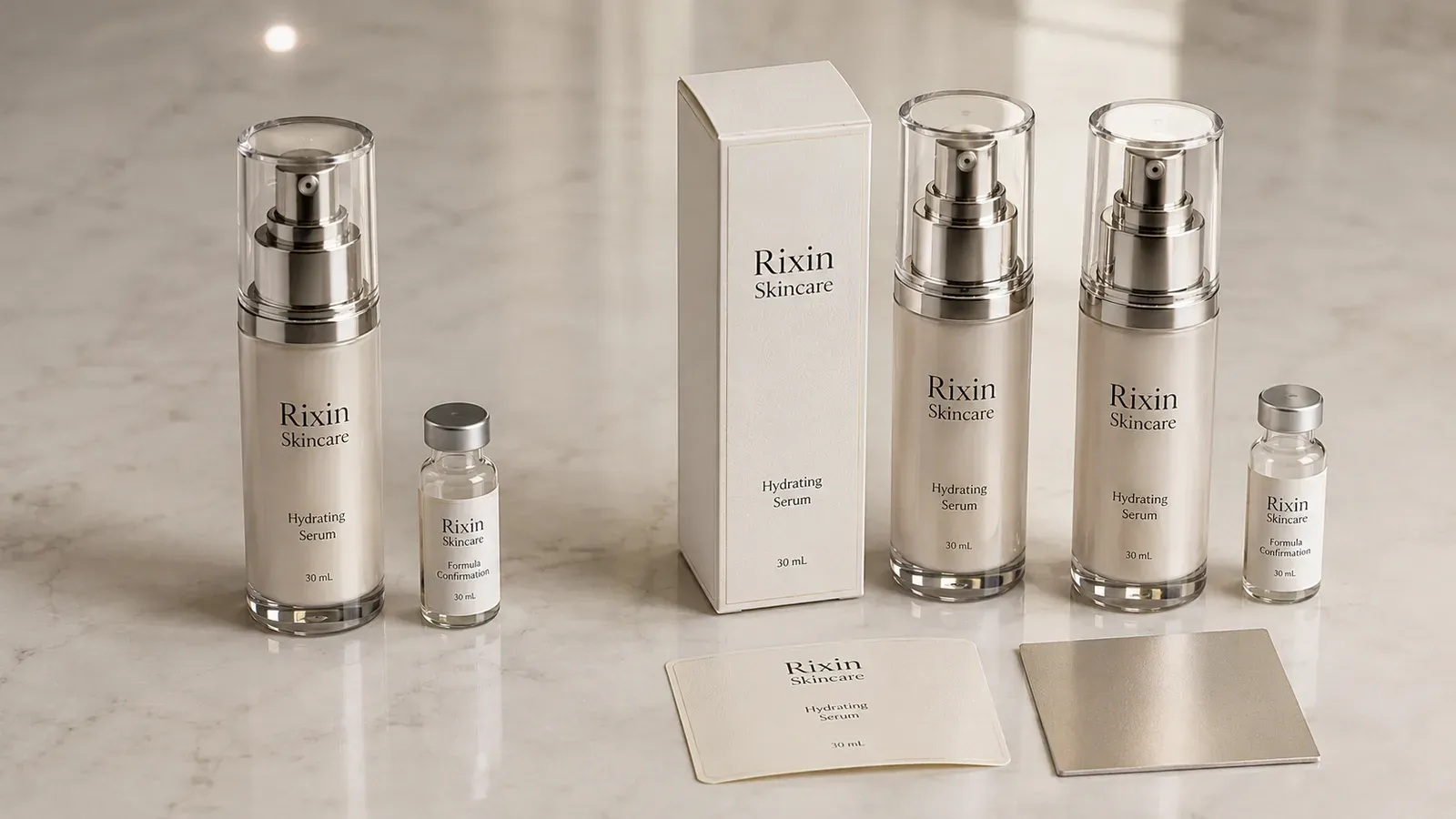
Match the label, printing, coating, foil, carton, insert, sleeve, and shrink film. Secondary packaging sits outside the primary container. A package shown in a mockup may not be priced. -
Testing and documentation
Identify which tests, product specifications, manufacturing records, or third-party services are included, optional, excluded, or pending. Requirements depend on the product, package, claims, market, and responsible parties. -
Delivery basis
Compare the same Incoterm and named place. An Incoterm is a delivery rule that allocates defined transport tasks, costs, and risks. The named place identifies where the obligation applies.
A Simple Example of Two Quotes With Different Scope
Hypothetical example only—no prices are implied.
| Scope item | Quote A | Quote B |
|---|---|---|
| Formula | Existing formula | Limited formula adjustment |
| Package | Stock bottle and label | Selected pump, printed bottle, and carton |
| Testing | Not included | Defined third-party test scope |
| Delivery | EXW factory | Delivery to a named destination |
Quote A may show a lower unit price because it covers less work. Quote B may cost more because its scope is broader. Neither is automatically better; normalise the scope before comparing price.
Use One Table for Every Manufacturer
Use the same comparison sheet for every quote.
| Comparison field | Quote A | Quote B | Quote C | Buyer notes |
|---|---|---|---|---|
| Product | Product type, formula route, formula version | |||
| SKU | Fill size, variants, quantity per SKU | |||
| Formula and filling | Formula or bulk scope, filling, assembly | |||
| Primary packaging | Container, closure, dispenser, seal | |||
| Decoration | Label, printing, coating, foil | |||
| Secondary packaging | Carton, insert, sleeve, shrink film | |||
| Samples and tooling | Samples, molds, printing plates, proofs | |||
| Testing and documents | Included, optional, third-party, pending | |||
| Quality and inspection | Agreed reference and inspection scope | |||
| Delivery | Incoterm, named place, freight, insurance | |||
| Commercial terms | Currency, payment terms, quote validity | |||
| Exclusions | Buyer-supplied, excluded, to be confirmed | |||
| Total | Unit price, one-time costs, total quoted project cost |
Filling means placing bulk formula into the agreed containers. Tooling means one-time items such as molds, printing plates, or setup tools.
Use three separate cost views:
- Unit price: cost per finished unit under the stated assumptions.
- One-time costs: tooling, plates, proofs, or initial development work where applicable.
- Total quoted project cost: the combined quoted amount for the specified quantity and included scope.
Treat every blank or TBC—to be confirmed—field as unresolved, not as included at no cost. Keep one-time charges visible rather than hiding them inside a unit-price comparison.
Read the Exclusions Before Choosing the Lowest Quote
The exclusions often explain why one offer looks cheaper.
Product and setup
- Samples and revision rounds
- Tooling, molds, printing plates, or setup
- Buyer-supplied artwork or packaging components
- Storage or delayed-collection charges, where applicable
Testing and documentation
- Third-party tests
- Product specifications or manufacturing records
- Market-side regulatory or responsible-party work
Delivery and commercial terms
- Quote currency and tax basis
- Freight and insurance
- Export or import formalities
- Duties, taxes, and local delivery
- Payment schedule, quote validity, and price-change conditions
The International Chamber of Commerce states that the Incoterms® 2020 rules allocate delivery responsibilities, costs, and risks. Under EXW (Ex Works), the seller generally makes the goods available at the named place. An EXW factory quote and a destination-delivery quote are not like-for-like until delivery scope is normalised.
Confirm the applicable delivery rule and named place in the quotation and contract. This article is a comparison guide, not trade or customs advice.
Review packaging components, decoration, labels, and cartons, and assess testing and documents against the confirmed product and market scope.
Quotation Comparison Red Flags
These points require clarification; they do not prove that a quote is wrong:
- The product specification or formula route is unclear.
- Fill size or quantity basis is missing.
- Packaging is described only as “standard.”
- Decoration appears in a mockup but is not priced.
- Testing or documentation is promised without a defined scope.
- Freight is included without an Incoterm and named place.
- A low unit price excludes major one-time costs.
- Several fields remain TBC but the total is treated as final.
- Quote validity and change conditions are absent.
- Different formula or packaging scopes are treated as equivalent.
A useful clarification request is:
Please confirm whether each listed item is included, excluded, optional, buyer-supplied, third-party, or still to be confirmed.
Ask for the response in writing before treating the offers as comparable.
Final Eight-Question Decision Check
Before selecting a quote, confirm:
- Same formula route?
- Same SKU count and fill size?
- Same quantity basis?
- Same packaging components?
- Same decoration and carton scope?
- Same testing and document assumptions?
- Same delivery term and named place?
- All exclusions and one-time costs recorded?
If any answer is no or unclear, the quotes are not ready for a final price comparison.
The strongest quote clearly defines what will be supplied, what remains open, what the buyer must provide, and what may change after review.